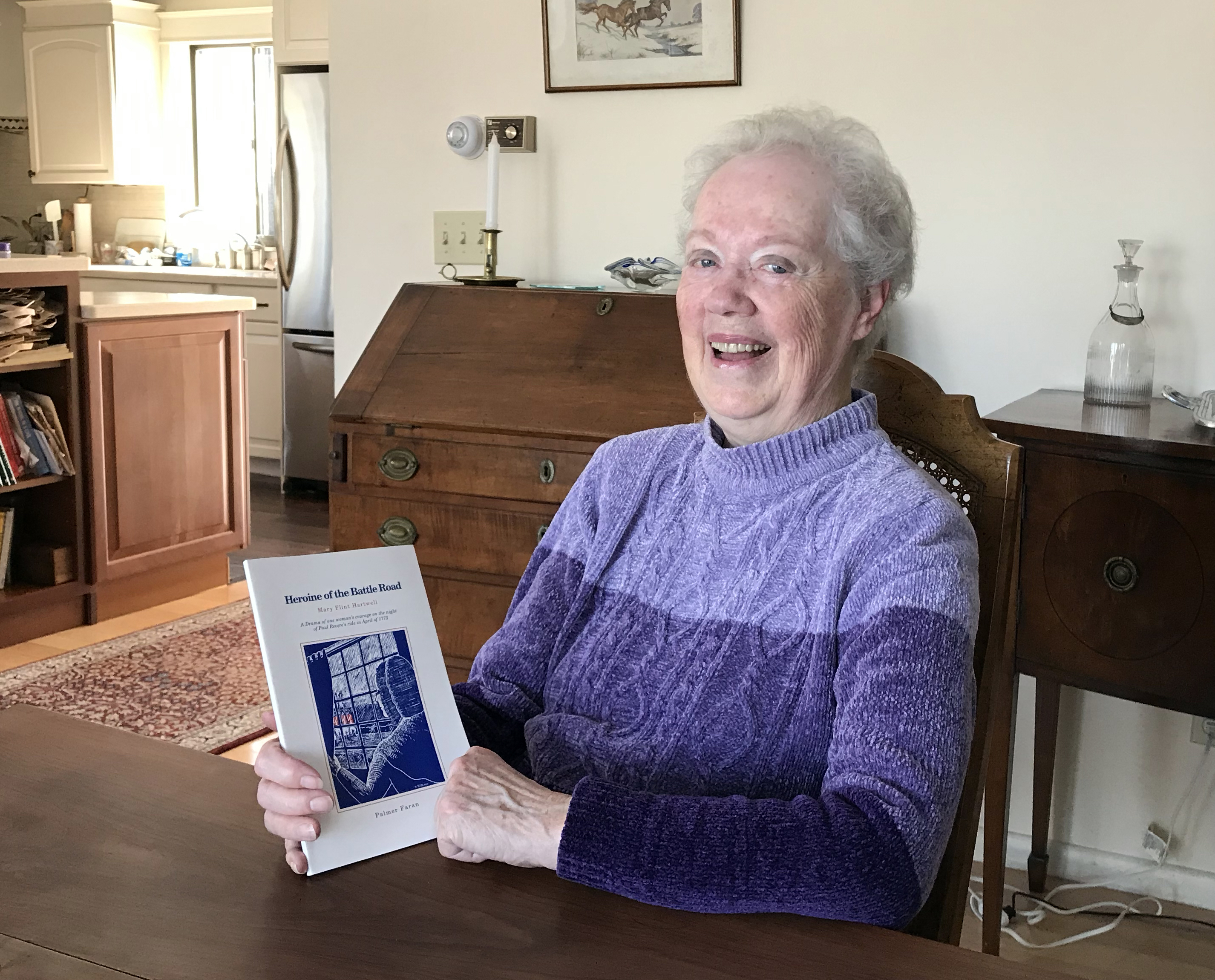
Palmer Faran holds a copy of “Heroine of the Battle Road.”
A newly digitized short play, available royalty-free on a town website, dramatizes the little-known role of Lincoln’s Mary Hartwell in the dramatic events that began the American Revolution.
The idea for the play, Heroine of the Battle Road, came about “because I’ve always been interested in the lives of ordinary people caught up in the events of history—those who fell through the cracks. Ordinary people were an important part of that,” said author and Lincoln resident Palmer Faran.
Mary Hartwell was the wife of Samuel Hartwell, a farmer and a Lincoln Minute Man. On the evening of April 18, 1775, she played a crucial role in passing the word about the British troops marching from Boston. Fast-forward to the early 1990s, when Mary Ann Hales suggested to her friend Faran, a veteran of Houghton Mifflin and American Heritage, that she write something about Mary.
After doing some research with the help of Lincoln town historian Jack MacLean, Faran realized there wasn’t enough material for a biography of Hartwell, so she wrote the story as a short play that could be read and performed in schools. Hales — a librarian and the owner of the Cottage Press in Lincoln — published Heroine of the Battle Road as paperback in 1995. The play was carried by the Minute National Historical Park and by several stores in Concord and Lincoln.
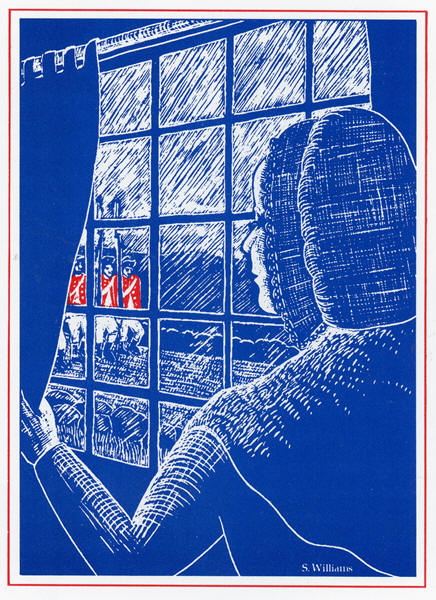
The cover of “Heroine of the Battle Road.”
In 1996, the play was performed at the Lincoln School, “and it was very much a successful community effort,” Faran said. Eventually the book went out of print, and work began on making it available to a larger audience via an online version. Jim Cunningham (like Faran, a Lincoln Historical Society board member, scanned illustrations and formatted the book (retyped by Celina Zanjewski) for the LHS website.
On Patriots’ Day in April, people will once again recall how Paul Revere was captured in Lincoln — but they can also learn how Mary Hartwell was a crucial link in the chain, warning Lincoln Minute Men Captain William Smith about the advancing British as her husband rode off to prepare for the coming fight.
As Mary Hartwell’s grandson George proudly notes in Heroine of the Battle Road, “The Lincoln Minute Men were the first to arrive at Concord and the North Bridge. That was because of Grandma.”
Leave a Reply